

Charpy Impact Testing Services (Charpy V-Notch)
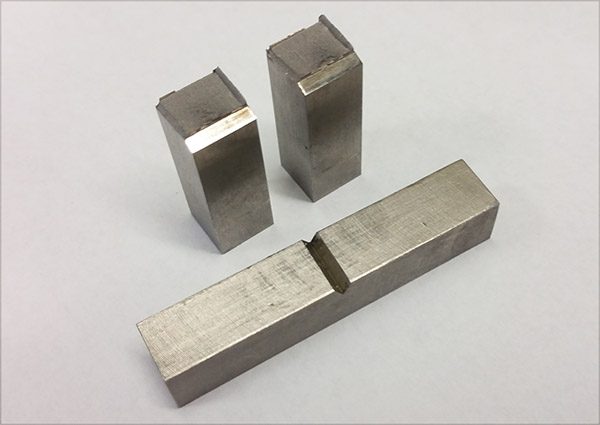
Knowing how a material reacts to a sudden, high-speed impact is just as critical as testing its everyday strength. Through charpy impact testing (also known as the Charpy V-Notch test), our labs precisely measure a material's toughness by:
- Dropping a heavy pendulum hammer from a controlled height to simulate real-world, high strain strikes
- Calculating the exact amount of energy your material absorbs at the moment it fractures
- Providing you with clear, accurate data on howyour components will hold up under sudden stress
Critical Impact Testing Factors
Our metallurgical experts analyze two primary behaviors during a Charpy test:
- Notch Toughness: We measure the exact total energy absorbed during sudden impact, while accounting for precise specimen sizes and geometry constraints.
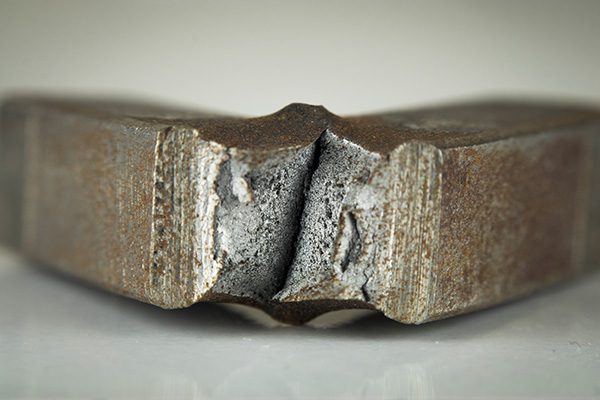
- Ductile-to-Brittle Transition Temperature (DBTT): Many materials become brittle as temperatures drop. We evaluate this transition by analyzing the fracture surfaces of broken specimens to estimate the exact percentage of ductile (shear) versus brittle (cleavage) failure.
Technical Specifications & Compliance Standards
Our laboratory is fully equipped to perform Charpy testing across a broad temperature spectrum to meet strict regulatory and industry benchmarks.
Temperature Capabilities
We offer precise environmental conditioning to test materials at exact temperatures ranging from -320°F to 400°F (covering both cryogenic and elevated temperature environments).
Standard Compliance
We test in strict accordance with major domestic and international standards:
- ASTM E23: Standard Test Methods for Notched Bar Impact Testing of Metallic Materials
- ASTM A370: Standard Test Methods and Definitions for Mechanical Testing of Steel Products
- ISO 148-1: Metallic materials — Charpy pendulum impact test
- JIS Z 2242: Method of Charpy impact test for metallic materials
The IMR Advantage: Precision Calibration
Small errors in a pendulum's starting angle or friction within the machine can heavily skew impact data. IMR Test Labs eliminates these variables through a rigorous focus on testing integrity:
- Advanced Instrumentation: We continuously invest in state-of-the-art pendulum impact machinery that automatically monitors starting angles, friction losses, and mid-process readings.
- Deep Metallurgical Expertise: Our multi-disciplinary team of PhDs, metallurgists, engineers, and technicians doesn't just hand you an energy number—we provide the insight needed to interpret complex material fractures.
- Rapid Results: We combine absolute technical precision with efficient laboratory workflows to deliver the fast turnaround times your project requires.
Charpy Impact FAQ's
Charpy impact testing relies on pendulum position, adjusted starting angles, and readings throughout the process, details that IMR Test is dedicated to ensuring are accurately measured and reported.
Charpy impact testing determines notch toughness, temperature-dependent ductile-brittle transition rate, and ductility of a material.
Charpy impact testing is performed on metals.
Bend Testing
Bond Strength Testing
Charpy Impact Testing (-320°F to 450°F)
Climbing Drum Adhesion of Sandwich Composites
Coating Adhesion
Coating Shear Fatigue
Coefficient of Thermal Expansion by TMA
Composite Testing (Fiber Reinforced)
Compression Set
Compressive Properties
Core Shear Properties of Sandwich Construction by Beam Flexure
Creep and Stress Rupture Testing
DMA (Dynamic Mechanical Analyzer)
Ductility
Elastic Modulus
Fatigue Testing
Filled Hole Tension & Compression
Flattening
Flat-wise Tensile Testing
Flexural Properties
Floating Roller Peel Strength
Fracture Mechanics
Gel Time
Hardness (Rockwell, Brinell, Durometer, Shore, Barcol, Knoop, Vickers, Macro Vickers)
Heat Aging
Heat Deflection by TMA
Heat Treatment (furnace to 2100°F)
Hydrogen Embrittlement
Hydrostatic Pressure
Interlaminar Shear
Jominy Hardenability
Lap Shear Testing
Machining & Specimen Preparation
Materialography
Modulus of Rupture (MOR)
n-Value (Strain Hardening Exponent)
Open Hole Tension and Compression
Pipeline Integrity Testing
r-Value (Plastic Strain Ratio)
Residual Strength of Composites After Impact
Rotating Beam Fatigue
Shear Testing of Rivets to ASTM B565, Single/Double
Short Beam Strength
Shot Peen Qualification
Single-Edged Notched beams (SENB)
Slow Strain Rate (G129)
Specimen Conditioning
Strain Gaging
Surface Roughness (ANSI/ASME B46.1)
T Peel Strength
Tear Resistance of Films & Sheeting
Tear - Rubbers & Elastomers
Tensile Testing
Torsional and Axial Fatigue (200 lb)
Tube Testing (Tensile, Flare, Hydrostatic)
Welder & Procedure Qualification
Wire/Spring Testing (Wrap, Coil, Bend)
Young's, Tangent and Chord Modulus (Room Temperature)
CHARPY TESTING SPECIFICATIONS
- ASTM A370
- ASTM E23
- ISO 148-1
- JIS Z 2242
RELEVANT ACCREDITATIONS
Click here for a complete list of accreditations and certifications for all IMR Test Labs locations.
