

XRD Analysis
Verifying the exact crystal structure and phase composition of your materials is essential to guaranteeing consistent performance and quality. We provide non-destructive X-Ray Diffraction (XRD) analysis to evaluate your crystalline materials by:
- Utilizing advanced diffractometers and the principles of Bragg's Law to precisely determine crystallographic structures, phase compositions, and atomic arrangements
- Analyzing metals, ceramics, minerals, and thin films without altering or damaging your samples
- Helping you identify specific compound phases, verify material properties, and maintain strict quality control across your manufacturing processes
XRD Analysis (X-Ray Diffraction)
XRD is a structural analysis technique used to identify the crystallographic properties of materials. Unlike standard chemical analysis, which identifies which elements are present, XRD reveals how those atoms are arranged.
The Power of Structural Identification
Because XRD is structure-based, it can differentiate between compounds containing the same elements that have vastly different properties.
How XRD Works: Bragg’s Law
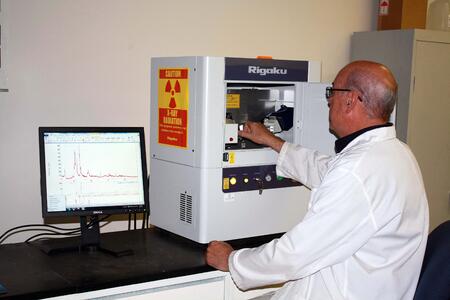
- Emission: A specialized diffractometer directs a monochromatic X-ray beam onto a sample.
- Scattering: The X-rays strike the crystal lattice and scatter.
- Interference: At specific angles, these scattered rays produce "constructive interference" patterns.
- Mapping: By measuring these patterns, we determine the atomic arrangement, lattice parameters, and crystalline phases.
INDUSTRY-SPECIFIC SOLUTIONS
We provide targeted XRD analysis to meet the standards of diverse sectors:
- Pharmaceuticals: Analyzing drug polymorphism and crystal size to ensure efficacy and stability.
- Energy & Battery: Characterizing catalysts, fuel cells, and battery materials to optimize performance.
- Geology & Mining: Mineral identification and mineralogical mapping for ore processing.
- Construction: Quality control for cement and ceramics to ensure long-term durability.
- Nanotechnology: Characterizing nanoparticles and thin films for electronics and sensors.
- Materials Science: Studying metals, polymers, and composites to tailor mechanical and thermal properties.
Materials Routinely Analyzed
- Metals & Alloys
- Ceramics & Minerals
- Thin Films & Coatings
- Polymers & Nanomaterials
- Powders & Clays
XRD ANALYSIS APPLICATIONS
| Capability | Industrial Applications |
|---|---|
| Phase Identification | Identifying corrosion products, oxides, nitrides, and minerals. |
| Quantitative Analysis | Determining concentrations of different crystalline phases in a mixture. |
| Crystallinity % | Measuring the ratio of crystalline to amorphous (non-structured) material. |
| Lattice Constants | Verifying palladium-based catalysts or hydroxyapatite for medical implants. |
| Size & Shape | Determining crystallite size for polycrystalline films and nanomaterials. |
XRD ANALYSIS FAQ'S
X-ray diffraction (XRD) analysis is a non-destructive analytical technique that involves shining X-rays onto a crystalline sample and measuring the diffraction pattern produced by the X-rays that are scattered by the crystal lattice. This diffraction pattern contains information about the crystal structure, phase composition, and other structural properties of the material being analyzed.
XRD analysis provides valuable information about the crystal structure, phase composition, crystal symmetry, lattice parameters, crystal size, and orientation of crystalline materials. It can also determine properties such as crystallographic texture, residual stress, and degree of crystallinity in materials.
XRD analysis can analyze a wide range of crystalline materials, including metals, ceramics, minerals, polymers, composites, thin films, and nanomaterials. It is particularly well-suited for studying crystalline materials with long-range order, such as crystalline powders, single crystals, and thin films.
XRD analysis has numerous applications in various fields, including materials science, pharmaceuticals, geology and mining, energy, nanotechnology, and construction. It is used for material characterization, quality control, process optimization, phase identification, phase quantification, and structure determination, among other applications.
XRD analysis offers several advantages, including non-destructive nature (samples can be recovered after analysis), high sensitivity, the ability to provide detailed structural information, a wide range of materials that can be analyzed, and quantitative analysis capability. It is a versatile and powerful technique for studying the crystallography of materials.
XRD analysis is primarily used for crystalline materials with long-range order. However, it can also provide information about amorphous materials, such as short-range order, atomic packing, and degree of amorphousness. Other complementary techniques, such as X-ray scattering, may be used for a more detailed analysis of amorphous materials.
While both can analyze surfaces and thin films, they provide different data:
- EDS (Energy Dispersive Spectroscopy): Tells you the chemical composition (the "what"). It identifies which elements are present in a specific area under a microscope.
- XRD (X-Ray Diffraction): Tells you the crystallographic phase (the "how"). It identifies how those atoms are bonded together.
- The Comparison: If you need to know if a coating is a specific nitride or oxide, XRD is the necessary tool.
Yes. This is a primary strength of XRD known as Polymorph Identification. For example, in the pharmaceutical or titanium industries, a sample may have the same chemical formula but different crystal structures. XRD is the only standard method to differentiate and quantify these different phases.
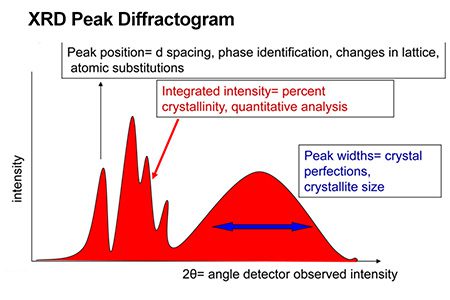
While XRD is primarily a tool for crystalline structures, it is highly effective at determining Percent Crystallinity.
- Crystalline materials produce sharp, distinct peaks.
- Amorphous materials (like glass or certain polymers) produce broad, humped "halos."
- Comparison: We can calculate the ratio between these two to help you understand how processing or cooling rates have affected the structural integrity of your polymer or ceramic.
- Phase ID (Qualitative): Simply identifies which compounds are present (e.g., "This sample contains Quartz and Calcite").
- Quantitative Phase Analysis (Rietveld Refinement): Provides a percentage breakdown of the mixture (e.g., "This sample is 75% Quartz and 25% Calcite").
Generally, XRD is considered non-destructive to the material's chemical bonds. However, for the most accurate results, samples are often ground into a fine powder to ensure random crystallite orientation. If your part must remain intact (e.g., a finished turbine blade), we can perform In-Situ XRD on the surface, though some geometry limitations may apply.
RELEVANT ACCREDITATIONS
Click here for a complete list of accreditations and certifications for all IMR Test Labs locations.
