

WHAT IS METALLOGRAPHY?
Metallography is a specialized material science technique used to study the physical structure and spatial distribution of the grains, phases, and inclusions within a metal or alloy.
By examining a material's microstructure at the microscopic level, engineers can gain critical insights into its mechanical properties, chemical composition, and overall performance. Metallography is a foundational tool for quality control, process validation (such as evaluating the effects of heat treating), and forensic root-cause failure analysis.
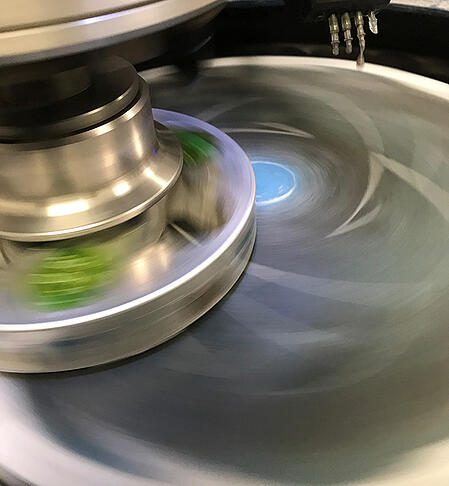
The Step-by-Step Metallographic Preparation Process
To reveal a material's true microstructure under a microscope, it must first undergo a rigorous, highly controlled extraction and polishing sequence. Any deformation introduced during this process can skew the final data.
- Precision Sectioning (Cutting): Specific regions of interest are extracted using wet abrasive cutters. Specialized care is taken to manage heat generation and maintain exact sample identification and geometric orientation.
- Mounting: The sectioned sample is encapsulated in a rigid polymer medium (compression molding or cold casting) to ensure flat edge retention and protect delicate surface coatings during subsequent steps.
- Grinding: The mounted specimen is exposed to successively finer silicon carbide grinding papers to remove surface damage from the cutting stage and establish a perfectly planar surface.
- Polishing: Utilizing diamond suspensions down to 1 micron on specialized polishing cloths, the sample is polished to a flawless, mirror-like finish.
- Chemical Etching: A material-specific chemical etchant is applied to the polished surface. The acid selectively attacks grain boundaries or distinct alloy phases, revealing the hidden microstructure.
Microscopic Evaluation & Analysis
Immediately following the drying of the etched sample, our metallurgists evaluate the specimen using high-resolution optical microscopes at magnifications ranging up to 1000X.
Our microstructural rating protocols include:
- Full-surface examinations across all specified areas of interest.
- High-magnification image capture documenting typical microstructural conditions.
- Microphotographs detailing worst-case field conditions (such as severe micro-cracking or heavy inclusion concentrations) for client reports.
Technical Capabilities: What We Detect
Our engineering team utilizes metallography to quantify a wide range of structural characteristics, ensuring your materials align perfectly with industry specifications:
- Grain Size Analysis: Verifying ASTM grain size numbers to predict tensile strength and material toughness.
- Phase Composition & Matrix Identification: Mapping the distribution of phases (e.g., ferrite, austenite, martensite) within an alloy.
- Porosity & Inclusion Ratings: Identifying hidden manufacturing voids, gas bubbles, or non-metallic inclusions that create weak points.
- Coating Thickness & Uniformity: Measuring diffusion layers, platings, and thermal spray coatings at high magnification.
The IMR Metallography Advantage
- Elite Quality Assurance: Our laboratories hold prestigious, globally recognized Nadcap and A2LA (ISO/IEC 17025) accreditations, ensuring your testing data is completely defensible.
- Advanced Material Preparations: From everyday carbon steels to challenging, ultra-hard superalloys, advanced ceramics, and complex multi-layered coatings, our lab technicians specialize in artifact-free sample preparation.
- Expanded Material Characterization: Our metallography labs work in tandem with our broader metallurgical suite, providing seamless transitions into microhardness testing, electrochemical corrosion simulations, and mercurous nitrate stress testing.
RELATED METALLURGICAL ANALYSIS METHODS
Alpha Case
Carburization
Case Depth
Certified Weld Inspections
Coatings Evaluations
Coating Thickness by SEM, Cross Section
Case Depth
Depth of Decarburization
Determination of Delta Ferrite Content
Determination of Volume Fraction by Point Count
Effective Case Depth
Failure Analysis
Fastener Discontinuities
Fluorescent Impregnation of Porous Coatings
Fractography
Grain Size
Inclusion Content/Rating
Intergranular Attack
Intergranular Oxidation
Light Microscopy - Macro, Micro & SEM Photography
Machining Evaluations
Macroetching
Microetching
Microhardness (Knoop, Vickers, MacroVickers)
Microstructure
Orientation in Microstructure
Particle Analysis (Distribution, ID, Size)
Phase Volume Determination
Plating Evaluations
Plating Thickness
Porosity of Metals, Ceramics & Composites
Prior Austenitic Grain Boundary Determination
Replication (ASTM E1351)
Quantitative Image Analysis
SEM Analysis
Surface Evaluation (Dubpernell Active Site Test ASTM B456 Appx 4)
Surface Topography
Thermal Spray Coating Analysis
Titanium Beta Transus Determination
Weld Qualification & Testing
Corrosion Failure Analysis
Dezincification Testing
Electrochemical Corrosion Testing
Environmental Stress Cracking (ESC)
Formicary (Ant’s Nest) Corrosion Evaluation
General and Pitting Corrosion Testing
Heat & Fluid Aging
Mercurous Nitrate Testing
Passivation Testing of Medical Components
Potentiodynamic Corrosion
Residual and Assembly Stress Testing of Copper Alloys
Sensitization Testing
Stress Corrosion Cracking (SCC)
Metallography is a specific technique of metallurgical analysis, an examination of metals and alloys, to determine their microstructure at the microscopic level.
Metallography data gives insight into phase composition, grain structure, and microscopic material features, in order to assess the integrity and quality of metals, behavior under certain conditions, mechanical properties, and side effects of treatments and processing.
Scanning electron microscopy (SEM), coating evaluation, microhardness testing, microstructural analysis of metals, and microstructural analysis of surface and subsurface damage are metallographic analysis methods.
Metallographic analysis can take a few hours or a few days, depending on the following factors sample complexity and analysis technique. IMR Test Labs has state-of-the-art equipment, metallography experts, and quick turnaround times.
RELEVANT ACCREDITATIONS
Click here for a complete list of accreditations and certifications for all IMR Test Labs locations.
