

Microhardness Testing: Vickers & Knoop Methods
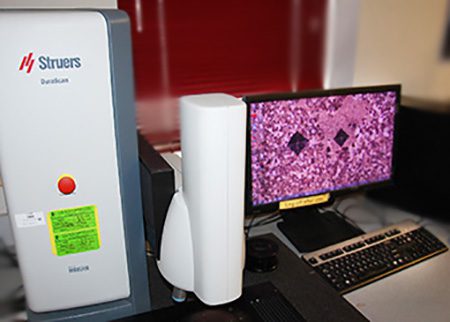
Microhardness testing evaluates a material’s resistance to localized plastic deformation under a series of light precision loads. This specialized metallurgical analysis is critical for testing small components, thin sheets, distinct microstructural phases, or determining the case hardness depth of heat-treated surfaces.
Our laboratory performs high-precision microhardness testing to verify raw material properties and validate manufacturing treatments in strict compliance with industry specifications.
Primary Testing Standard All microhardness evaluations are performed and calibrated in strict accordance with ASTM E384: Standard Test Method for Microindentation Hardness of Materials.
Choosing the Right Microhardness Method
While both techniques utilize low-force diamond indenters, they are optimized for entirely different material types and geometries:
The Vickers Microhardness Method
The Vickers test uses a square-based pyramid diamond indenter to create a symmetrical, square impression. Because the indenter geometry remains constant across all load scales, it creates a continuous and highly versatile hardness profile.
- Best Used For: Testing a exceptionally wide range of metallic alloys, microstructural phases, and welded joints.
- Key Advantage: The geometric scale allows for direct comparison of hardness values across a broad spectrum of light-to-heavy loads.
The Knoop Microhardness Method
The Knoop test uses an elongated, rhombohedral diamond indenter that creates a long, shallow impression. Because it penetrates much less deeply into the material than the Vickers indenter under the same load, it minimizes structural displacement.
- Best Used For: Extremely brittle materials (such as advanced ceramics or industrial glass), thin metallic sheets, or checking hardness gradients directly adjacent to an edge.
- Key Advantage: Prevents cracking or fracturing in fragile materials, providing highly accurate near-surface hardness readings.
METALLURGICAL LAB SERVICES
Alpha Case
Carburization
Case Depth
Certified Weld Inspections
Coatings Evaluations
Coating Thickness by SEM, Cross Section
Case Depth
Depth of Decarburization
Determination of Delta Ferrite Content
Determination of Volume Fraction by Point Count
Effective Case Depth
Failure Analysis
Fastener Discontinuities
Fluorescent Impregnation of Porous Coatings
Fractography
Fracture Mechanics
Grain Size
Inclusion Content/Rating
Intergranular Attack
Intergranular Oxidation
Light Microscopy - Macro, Micro & SEM Photography
Machining Evaluations
Macroetching
Microetching
Microhardness (Knoop, Vickers, MacroVickers)
Microstructure
Orientation in Microstructure
Particle Analysis (Distribution, ID, Size)
Phase Volume Determination
Pipeline Integrity
Plating Evaluations
Plating Thickness
Porosity of Metals, Ceramics & Composites
Prior Austenitic Grain Boundary Determination
Replication (ASTM E1351)
Quantitative Image Analysis
SEM-EDS
Surface Evaluation (Dubpernell Active Site Test ASTM B456 Appx 4)
Surface Topography
Thermal Spray Coating Analysis
Titanium Beta Transus Determination
Weld Qualification & Testing
RELATED HARDNESS TESTS-METALS
Brinell Hardness (500, 1000, 1500, 3000Kgf)
Rockwell Hardness (A, B, C, F, L, 15N, 30N, 45N, 15T, 30T, 45T, E, 15Y)
Knoop Microhardness (10-1000gf)
Macro-Vickers Microhardness (1-10kg)
Vickers Microhardness (10-1000gf)
RELATED HARDNESS TESTS-NON-METALLICS
Barcol Hardness
Durometer Hardness Test/Shore Hardness (A, D, M)
Rockwell Hardness (E, R, L, M) Non-conditioned lab
RELEVANT ACCREDITATIONS
Click here for a complete list of accreditations and certifications for all IMR Test Labs locations.
