

Fracture Toughness Testing Services
Fracture Toughness Testing & Fracture Mechanics
Predicting how micro-flaws behave under operational stress is critical to preventing catastrophic, unpredictable component failures. IMR Test Labs provide specialized fracture mechanics testing to evaluate crack growth and structural integrity by:
- Assisting with custom specimen design, fixture creation, and precise test parameter selection tailored to your real-world operating conditions
- Delivering quantitative analytical data to accurately predict when a crack will initiate, how fast it will propagate, and when critical failure occurs
- Evaluating micro-flaws and structural discontinuities introduced during manufacturing, processing, or machining to ensure long-term field reliability
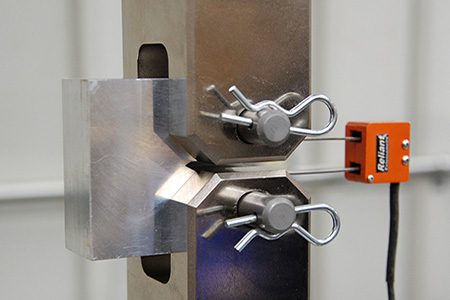
The Core Objective of Fracture Toughness Testing
Fracture toughness testing measures a material's structural resistance to the extension of an existing crack. Our laboratory evaluates the complex, multi-variable relationship between four critical pillars:
- Applied Loading: The mechanical forces and cyclic stresses placed on the component.
- Environmental Factors: Temperature and corrosive elements that accelerate degradation.
- Presence of Flaws: Pre-existing cracks, voids, or crack-like defects.
- Material Properties: The inherent physical resistance of the base material.
Materials & Specimen Geometries We Evaluate
Our laboratory accommodates an extensive array of material compositions and standardized specimen geometries to precisely replicate your component's structural configuration.
Materials Tested
- Metals: Ferrous and non-ferrous alloys, weldments, and cast components.
- Advanced Materials: High-performance polymers and structural fiber-reinforced composites.
Specimen Configurations & Testing Modes
We handle advanced specimen preparation and machining in-house for a wide variety of geometry profiles:
- Tension-Based Specs: Compact Tension (CT), Middle Tension (MT), Single-Edge Notched Tension (SENT), Center Cracked Tension (CCT), and Surface Cracked Tension (SCT).
- Bending-Based Specs: Single-Edge Notched Bend (SENB / Three-Point Bend) and Extended Compact Tension (ECT).
- Composite Testing: Delamination and fracture profiling under Mode I (Opening), Mode II (Sliding/Shear), and Mode III (Tearing) loading conditions.
Accredited Testing Standards
IMR Test Labs provides certified, accredited testing to major international standard specifications, ensuring reproducible and globally accepted data:
- ASTM E399: Standard Test Method for Linear-Elastic Plane-Strain Fracture Toughness ($K_{Ic}$) of Metallic Materials.
- ASTM E1820: Standard Test Method for Measurement of Fracture Toughness, spanning linear-elastic, elastic-plastic, $J$-integral, and CTOD criteria.
Commercial & Engineering Benefits
Integrating fracture mechanics data into your product lifecycle yields measurable commercial advantages:
- Informed Material Selection: Make objective, side-by-side data comparisons to choose the most resilient material before moving into full-scale production.
- Accurate Lifespan Prediction: Determine precisely how long components can withstand operational stresses before crack propagation compromises safety.
- Risk & Liability Mitigation: Isolate and eliminate hazardous brittle-fracture risks, protecting end-users and shielding your organization from expensive product recalls.
- Comprehensive Material Profiles: Fracture toughness testing seamlessly integrates with our broader mechanical testing catalog—including fatigue testing, corrosion analysis, and forensic failure analysis—to build a complete lifecycle map of your material.
Bend Testing
Bond Strength Testing
Charpy Impact Testing (-320°F to 450°F)
Climbing Drum Adhesion of Sandwich Composites
Coating Adhesion
Coating Shear Fatigue
Coefficient of Thermal Expansion by TMA
Composite Testing (Fiber Reinforced)
Compression Set
Compressive Properties
Core Shear Properties of Sandwich Construction by Beam Flexure
Creep and Stress Rupture Testing
DMA (Dynamic Mechanical Analyzer)
Ductility
Elastic Modulus
Fatigue Testing
Filled Hole Tension & Compression
Flattening
Flat-wise Tensile Testing
Flexural Properties
Floating Roller Peel Strength
Fracture Mechanics
Gel Time
Hardness (Rockwell, Brinell, Durometer, Shore, Barcol, Knoop, Vickers, Macro Vickers)
Heat Aging
Heat Deflection by TMA
Heat Treatment (furnace to 2100°F)
Hydrogen Embrittlement
Hydrostatic Pressure
Indentation Toughness
Interlaminar Shear
Jominy Hardenability
Lap Shear Testing
Machining & Specimen Preparation
Materialography
Modulus of Rupture (MOR)
n-Value (Strain Hardening Exponent)
Open Hole Tension and Compression
Pipeline Integrity Testing
r-Value (Plastic Strain Ratio)
Residual Strength of Composites After Impact
Rotating Beam Fatigue
Shear Testing of Rivets to ASTM B565, Single/Double
Short Beam Strength
Shot Peen Qualification
Single-Edged Notched beams (SENB)
Slow Strain Rate (G129)
Specimen Conditioning
Strain Gaging
Surface Roughness (ANSI/ASME B46.1)
T Peel Strength
Tear Resistance of Films & Sheeting
Tear - Rubbers & Elastomers
Tensile Testing
Torsional and Axial Fatigue (200 lb)
Tube Testing (Tensile, Flare, Hydrostatic)
Welder & Procedure Qualification
Wire/Spring Testing (Wrap, Coil, Bend)
Young's, Tangent and Chord Modulus (Room Temperature)
