

High Temperature Fatigue Testing Services
High-Temperature Fatigue Testing Services
Replicating extreme service conditions is essential to verifying component performance under intense mechanical and thermal stresses. IMR Test Labs provides precision fatigue testing to evaluate your high-stress parts by:
- Executing strain-controlled fatigue testing at elevated temperatures up to 1800° to simulate mechanical loading in the plastic region
- Evaluating critical components - such as turbine blades in jet engines and power plants - for the aerospace, automotive, and power generation industries
- Delivering Nadcap-compliant results that adhere strictly to ISO 12016 and ASTM E606 standards to ensure structural reliability in the field
Performance & Compliance
- Thermal Range: Testing capabilities up to 1800°F.
- Standards: Nadcap compliant; adheres to ISO 12016 and ASTM E606.
- Application: Strain-controlled fatigue testing to simulate mechanical loading in the plastic region.
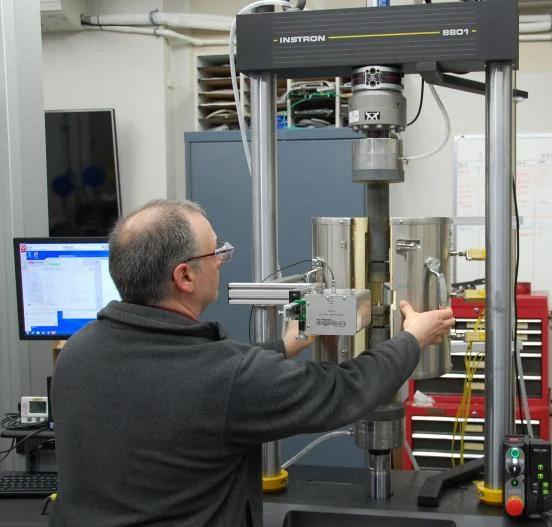
Core Capabilities
| Feature | Benefit |
|---|---|
| All-Electric Actuator | Precise slow-speed control; silent, hydraulic-free operation. |
| AlignPRO Fixture | Ensures exact loadstring alignment via integrated software. |
| 3-Zone Furnace | Cascade control for an optimized temperature gradient. |
| LCF3 Software Suite | Streamlined setup and analysis of hysteresis loops. |
| High-Stiffness Frame | Maximizes lateral/axial stability during reverse stress testing. |
Ready to start your project?
4 Material Transformations in High-Temperature Fatigue
Understanding how heat alters microstructure is critical for maintaining material integrity. High-temperature fatigue testing reveals these four key transformations:
- Microstructural Evolution: Tracking grain growth and phase changes under stress.
- Oxidation & Corrosion: Assessing how surface degradation accelerates crack initiation.
- Creep-Fatigue Interaction: Evaluating permanent deformation from sustained high-heat loads.
- Mechanical Property Degradation: Identifying the exact point where yield strength and stiffness fail.
Adhesion (Peel) Testing
Bend Testing
Bond Strength Testing
Charpy Impact Testing (-320°F to 450°F)
Climbing Drum Adhesion of Sandwich Composites
Coating Adhesion
Coating Shear Fatigue
Coefficient of Thermal Expansion by TMA
Composite Testing (Fiber Reinforced)
Compression Set
Compressive Properties
Core Shear Properties of Sandwich Construction by Beam Flexure
Creep and Stress Rupture Testing
DMA (Dynamic Mechanical Analyzer)
Ductility
Elastic Modulus
Fatigue Testing
Filled Hole Tension & Compression
Flattening
Flat-wise Tensile Testing
Flexural Properties
Floating Roller Peel Strength
Fracture Mechanics
Gel Time
Hardness (Rockwell, Brinell, Durometer, Shore, Barcol, Knoop, Vickers, Macro Vickers)
Heat Aging
Heat Deflection by TMA
Heat Treatment (furnace to 2100°F)
Hydrogen Embrittlement
Hydrostatic Pressure
Indentation Toughness
Interlaminar Shear
Jominy Hardenability
Lap Shear Testing
Machining & Specimen Preparation
Materialography
Modulus of Rupture (MOR)
n-Value (Strain Hardening Exponent)
Open Hole Tension and Compression
Pipeline Integrity Testing
r-Value (Plastic Strain Ratio)
Residual Strength of Composites After Impact
Rotating Beam Fatigue
Shear Testing of Rivets to ASTM B565, Single/Double
Short Beam Strength
Shot Peen Qualification
Single-Edged Notched beams (SENB)
Slow Strain Rate (G129)
Specimen Conditioning
Strain Gaging
Surface Roughness (ANSI/ASME B46.1)
T Peel Strength
Tear Resistance of Films & Sheeting
Tear - Rubbers & Elastomers
Tensile Testing
Torsional and Axial Fatigue (200 lb)
Tube Testing (Tensile, Flare, Hydrostatic)
Welder & Procedure Qualification
Wire/Spring Testing (Wrap, Coil, Bend)
Young's, Tangent and Chord Modulus (Room Temperature)
RELEVANT ACCREDITATIONS
Click here for a complete list of accreditations and certifications for all IMR Test Labs locations.
