

Bond Pull Testing
Bond Pull Testing & Adhesion Analysis Services
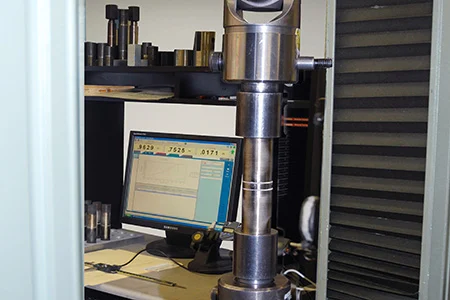
Bond pull testing (or pull-off adhesion testing) ensures the structural integrity of your adhesive joints by:
- Evaluating the true strength between your bonded materials
- Measuring the exact foce it takes to break the bond using specialized lab equipment
- Verifying that your final products meet rigorous safety and quality standards
Applications of Bond Pull Testing
Whether you are designing a new product or troubleshooting a field failure, bond pull testing provides critical, data-driven insights across the product lifecycle:
- Adhesive Selection & Material Evaluation: Compare the performance of different adhesives and surface treatments (cleaning, priming, or roughening) to find the perfect match for your specific application.
- Quality Control & Process Validation: Monitor process variability (curing time, temperature, and pressure) and detect hidden defects like incomplete curing or poor surface preparation.
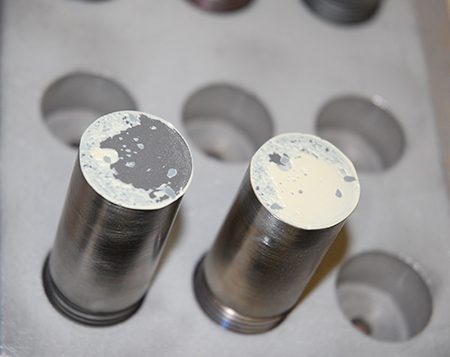
- Root Cause Failure Analysis: When a bonded assembly fails, we determine the exact mode of failure:
- Adhesive failure: A break right at the interface between the adhesive and the substrate.
- Cohesive failure: A break within the adhesive layer itself.
- Substrate failure: The structural material itself fails before the adhesive bond breaks.
- Compliance Standards: Verify that your bonded assemblies meet or exceed regulatory requirements and industry-specific minimum adhesion limits.
The Bond Pull Testing Process
To ensure highly repeatable and accurate data, our laboratory follows a strict testing sequence:
- Fixture Attachment: Standard test coupons are bonded between pull fixtures, or specialized studs are attached directly to the component surface.
- Perpendicular Alignment: Fixtures are precisely aligned to apply a perfectly perpendicular tensile force. This prevents "cleaving effects" (peeling) that can skew stress calculations.
- Automated Loading: Computer-controlled test frames apply a smooth, continuous pulling force, capturing real-time load data until structural separation occurs.
- Post-Test Fractography: Our team conducts a visual and microscopic examination of the fractured surface to classify the failure mode (adhesive, cohesive, or mixed).
Specialization: ASTM C633 Testing for Thermal Spray Coatings
For specialized surface coatings, IMR Test Labs provides standardized testing under ASTM C633 (Standard Test Method for Adhesion or Cohesion Strength of Thermal Spray Coatings).
This widely accepted standard dictates the exact equipment, specimen preparation, and calculation methods required to evaluate the bond strength of thermal spray coatings to a substrate, or between individual coating layers. It is an indispensable tool for quality control, process optimization, and material qualification in high-performance surface engineering.
RELEVANT ACCREDITATIONS
Click here for a complete list of accreditations and certifications for all IMR Test Labs locations.
MECHANICAL TESTING METHODS
Abrasion (Taber)
Adhesion (Peel) Testing
Bend Testing
Bond Strength Testing
Charpy Impact Testing (-320°F to 450°F)
Climbing Drum Adhesion of Sandwich Composites
Coating Adhesion
Coating Shear Fatigue
Coefficient of Thermal Expansion by TMA
Composite Testing (Fiber Reinforced)
Compression Set
Compressive Properties
Core Shear Properties of Sandwich Construction by Beam Flexure
Creep and Stress Rupture Testing
DMA (Dynamic Mechanical Analyzer)
Ductility
Elastic Modulus
Fatigue Testing
Filled Hole Tension & Compression
Flattening
Flat-wise Tensile Testing
Flexural Properties
Floating Roller Peel Strength
Fracture Mechanics
Gel Time
Hardness (Rockwell, Brinell, Durometer, Shore, Barcol, Knoop, Vickers, Macro Vickers)
Heat Aging
Heat Deflection by TMA
Heat Treatment (furnace to 2100°F)
Hydrogen Embrittlement
Hydrostatic Pressure
Indentation Toughness
Interlaminar Shear
Jominy Hardenability
Lap Shear Testing
Machining & Specimen Preparation
Materialography
Modulus of Rupture (MOR)
n-Value (Strain Hardening Exponent)
Open Hole Tension and Compression
Pipeline Integrity Testing
r-Value (Plastic Strain Ratio)
Residual Strength of Composites After Impact
Rotating Beam Fatigue
Shear Testing of Rivets to ASTM B565, Single/Double
Short Beam Strength
Shot Peen Qualification
Single-Edged Notched beams (SENB)
Slow Strain Rate (G129)
Specimen Conditioning
Strain Gaging
Surface Roughness (ANSI/ASME B46.1)
T Peel Strength
Tear Resistance of Films & Sheeting
Tear - Rubbers & Elastomers
Tensile Testing
Torsional and Axial Fatigue (200 lb)
Tube Testing (Tensile, Flare, Hydrostatic)
Welder & Procedure Qualification
Wire/Spring Testing (Wrap, Coil, Bend)
Young's, Tangent and Chord Modulus (Room Temperature)
Industries We Serve
Our laboratory delivers certified testing and statistical process control (SPC) for industries with zero-tolerance for bond failures:
- Aerospace & Defense: Validating structural bonding, composite panels, and critical components compliant with AS9100 and strict regulatory mandates.
- Automotive: Supporting material development, OEM specifications, and manufacturing process validation compliant with ISO/TS 16949.
- Electronics: Evaluating the micro-reliability of wire bonds, die bonds, flip-chip bonds, and solder joints in delicate electronic assemblies.
- Construction: Assessing the long-term integrity of concrete bonding, flooring installations, insulation, and exterior facade/cladding systems.
- General Manufacturing: Assisting with raw adhesive batch variability testing and end-to-end quality assurance.
BOND PULL TESTING FAQ'S
Bond pull testing is a method used to measure the adhesion or bond strength of adhesive bonds, coatings, or other bonded assemblies. It involves applying a controlled force to a bonded sample until the bond fails or debonds and measuring the maximum force or stress at which this occurs.
Bond pull testing is important because it provides quantitative data on the strength and integrity of bonded assemblies. It is used for quality control, process optimization, material selection, and failure analysis in various industries, such as automotive, aerospace, electronics, construction, and manufacturing. Bond pull testing helps ensure that bonded assemblies meet desired performance requirements and aids in identifying and addressing potential issues related to bonding processes, materials, or designs.
Bond pull testing is commonly used in industries where adhesives, coatings, or bonded assemblies are used, such as automotive, aerospace, electronics, construction, and manufacturing. Some common applications of bond pull testing include evaluating adhesive materials, assessing surface treatments, determining material compatibility, evaluating material aging or degradation, determining bond strength of new materials, and conducting failure analysis.
Several factors can affect bond pull test results, including the type and formulation of the adhesive or coating, the surface preparation of the substrates, the testing conditions (e.g., temperature, humidity), the rate of loading or displacement during the test, and the geometry of the bonded samples. It is important to carefully control these factors during bond pull testing to obtain accurate and reliable results.
Several standards are published by organizations such as ASTM International, ISO (International Organization for Standardization), and others that provide guidelines for bond pull testing in specific industries or applications. Examples of such standards include ASTM D4541 for bond strength of coatings, ASTM C633 for bond strength of thermal spray coatings, ISO 4624 for bond strength of paint coatings, and ASTM D1002 for bond strength of plastics, among others.
