

Hardness Testing Services: Metals & Non-Metals
Determining a material's resistance to deformation is key to ensuring long-term structural integrity. IMR Test Labs foundational hardness testing to evaluate your components by:
- Measuring a material's resistance to surface deformation through precise mechanical evaluation
- Asessing raw materials, new product developments, and incoming inventory for quality control
- Validating heat treatment processes, verifying design specifications, and rapidly troubleshooting underperforming components in the field
Macro Hardness Testing (Bulk Materials)
Macro hardness methods utilize heavier loads to evaluate the bulk properties of metals, making them ideal for large components, castings, and forgings.
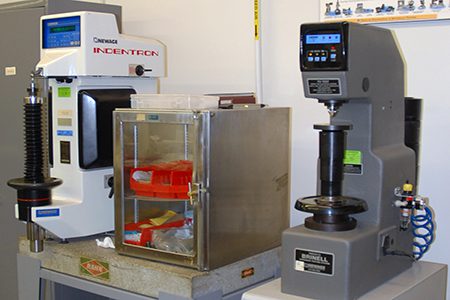
- Rockwell Hardness Test: Measures the depth of residual indentation under a primary load compared to a minor preload. It is highly valued for its speed and direct digital readout.
- Standard Scales Available: A, B, C, E, F, L
- Superficial Scales (Thin Materials): 15N, 30N, 45N, 15T, 30T, 45T, 15Y
- Brinell Hardness Test: Uses a heavy load (typically 500 kgf to 3000 kgf) and a spherical tungsten carbide ball indenter. By measuring the diameter of the resulting indentation, it provides an accurate average hardness across materials with coarse microstructures or surface irregularities.
Microhardness Testing (Small Components & Microstructures)
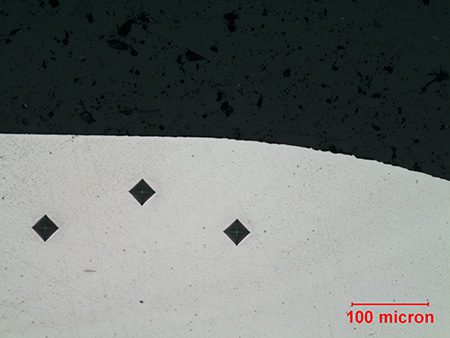
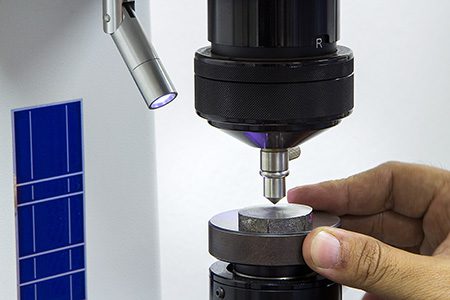
When evaluating thin sheets, case-hardened depths, individual microstructural phases, or small parts, microhardness testing applies lighter forces to ensure pinpoint accuracy.
- Vickers Hardness Test: Utilizes a square-based pyramid diamond indenter to create an impression. Because the geometry of the indenter is constant, the Vickers scale is continuous and universally applicable across all hardness levels, from soft aluminum to extremely hard alloys.
- Micro-Vickers: Applied loads from 10 gf to 1000 gf.
- Macro-Vickers: Applied loads from 1 kgf to 100 kgf for deep-penetration analysis.
- Knoop Hardness Test: Employs an elongated, rhombohedral diamond indenter that creates a significantly shallower, longer impression than the Vickers test. This makes it the premier choice for incredibly thin coatings, brittle materials, or samples where cracking must be avoided.
- Knoop Range: Applied loads from 10 gf to 1000 gf.
Testing Capabilities by Material Type
| Material Classification | Recommended Hardness Methods | Common Test Applications |
|---|---|---|
| Ferrous & Non-Ferrous Metals |
Rockwell, Brinell, Vickers | Raw stock verification, weldments, heat-treat verification |
| Advanced Ceramics & Glass |
Knoop, Micro-Vickers | Brittle material evaluation, structural integrity |
| Engineered Coatings & Platings |
Knoop, Superficial Rockwell | Thin-film testing, surface layer durability |
| Polymers & Elastomers |
Durometer (Shore A/D), Barcol | Non-metallic hardness, curing validation |
MECHANICAL TESTING METHODS
Abrasion (Taber)
Adhesion (Peel) Testing
Bend Testing
Bond Strength Testing
Charpy Impact Testing (-320°F to 450°F)
Climbing Drum Adhesion of Sandwich Composites
Coating Adhesion
Coating Shear Fatigue
Coefficient of Thermal Expansion by TMA
Composite Testing (Fiber Reinforced)
Compression Set
Compressive Properties
Core Shear Properties of Sandwich Construction by Beam Flexure
Creep and Stress Rupture Testing
DMA (Dynamic Mechanical Analyzer)
Ductility
Elastic Modulus
Fatigue Testing
Filled Hole Tension & Compression
Flattening
Flat-wise Tensile Testing
Flexural Properties
Floating Roller Peel Strength
Fracture Mechanics
Gel Time
Hardness (Rockwell, Brinell, Durometer, Shore, Barcol, Knoop, Vickers, Macro Vickers)
Heat Aging
Heat Deflection by TMA
Heat Treatment (furnace to 2100°F)
Hydrogen Embrittlement
Hydrostatic Pressure
Indentation Toughness
Interlaminar Shear
Jominy Hardenability
Lap Shear Testing
Machining & Specimen Preparation
Materialography
Modulus of Rupture (MOR)
n-Value (Strain Hardening Exponent)
Open Hole Tension and Compression
Pipeline Integrity Testing
r-Value (Plastic Strain Ratio)
Residual Strength of Composites After Impact
Rotating Beam Fatigue
Shear Testing of Rivets to ASTM B565, Single/Double
Short Beam Strength
Shot Peen Qualification
Single-Edged Notched beams (SENB)
Slow Strain Rate (G129)
Specimen Conditioning
Strain Gaging
Surface Roughness (ANSI/ASME B46.1)
T Peel Strength
Tear Resistance of Films & Sheeting
Tear - Rubbers & Elastomers
Tensile Testing
Torsional and Axial Fatigue (200 lb)
Tube Testing (Tensile, Flare, Hydrostatic)
Welder & Procedure Qualification
Wire/Spring Testing (Wrap, Coil, Bend)
Young's, Tangent and Chord Modulus (Room Temperature)
RELATED HARDNESS TESTING SPECIFICATIONS
ASTM A370
ASTM B578
ASTM D2240
ASTM D2583
ASTM E10
ASTM E18
ASTM E384
ASTM F606 / F606M
ISO 868
SAE J429
SAE J995
...and more
INDUSTRIES SERVED BY METAL HARDNESS TESTING
- Aerospace
- Automotive
- Energy
- Manufacturing
- Medical
- Metal Foundries
- Nuclear Power
- Petroleum
RELEVANT ACCREDITATIONS
Click here for a complete list of accreditations and certifications for all IMR Test Labs locations.
